Why Your Mac Cannot Render Ads Fast Enough (And What to Use)
Why Your Mac Cannot Render Ads Fast Enough (And What to Use)
If your video editor’s laptop sounds like a jet engine when exporting videos, your workflow is fundamentally broken. Here is how cloud assembly solves the bottleneck.
You finally convinced your executive team to adopt a high-velocity testing model. The media buyer has built the perfect Meta Ads Sandbox architecture. You have a spreadsheet with 50 different variations of a video ad that need to be launched by Friday to counteract algorithmic fatigue.
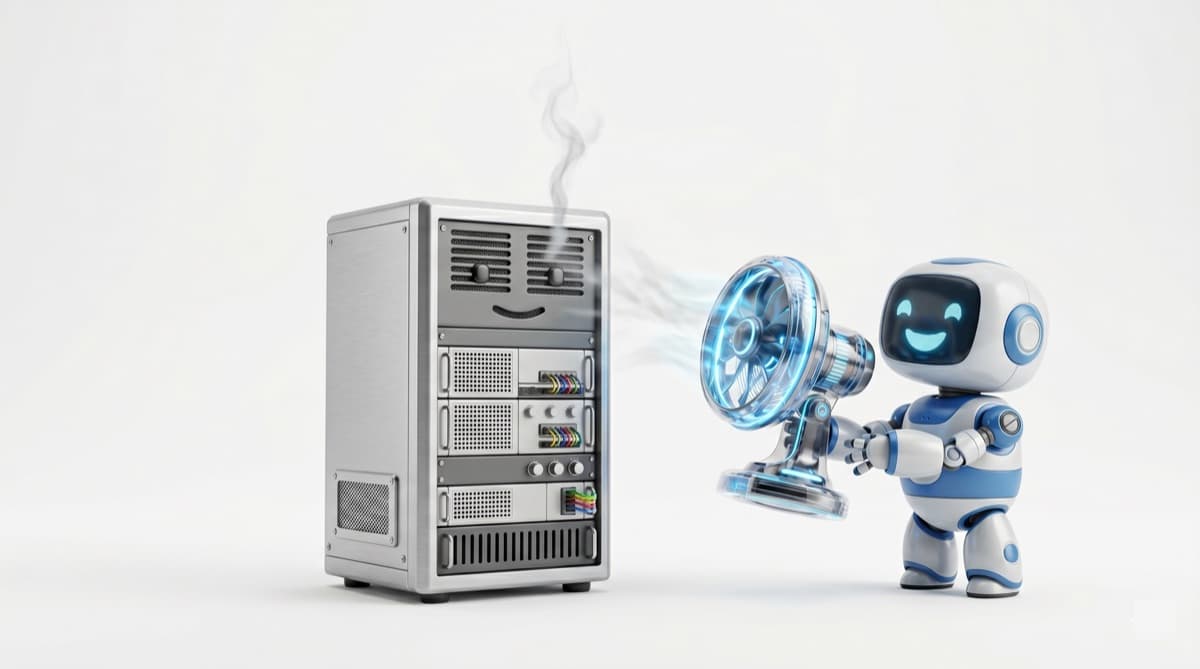
Your senior video editor opens Adobe Premiere Pro. They painstakingly duplicate timelines, manually swap out 50 different text hooks, align the audio tracks perfectly, and hit ´´Export All.´´ Immediately, the fans on their MacBook Pro spin up until the laptop sounds like a jet engine. The progress bar says: ´´Estimated time remaining: 6 Hours.´´ The laptop effectively freezes, completely paralyzing the editor for the rest of the day.
This is the compute bottleneck. Traditional, local hardware was never designed to mass-produce programmatic variations of a video. If you rely on a local graphics card to render your creative permutations, you are placing a hard, physical cap on your agency´s ability to scale.
Why is local video rendering a bottleneck for performance marketing?
Local video rendering places a hard physical cap on an agency's ability to scale output. Waiting for large video files to export on a local GPU wastes expensive human payroll, prevents strategic work, and requires massive hardware investments for every new hire, severely restricting ad testing velocity.
Let´s break down the hidden financial cost of local, manual rendering. If a senior video editor is making $50 an hour, and they spend 4 hours a week simply staring at a progress bar while their machine struggles to export high-resolution H.264 files, that is $800 a month in pure, evaporated payroll per editor.
But the raw payroll waste is actually the smallest part of the problem. The real cost is the massive loss of strategic opportunity. During those 4 hours of rendering time, your highly skilled creative talent cannot brainstorm new concepts, analyze competitor ads, or study the retention metrics of last week´s test. The machine has effectively hijacked the human.
In a fast-growing performance agency, trying to scale creative output from 20 videos a week to 200 videos a week using local hardware is a logistical nightmare. It means buying $4,000 top-tier computers for every new hire and constantly managing local storage servers. This linearly scales your overhead costs with your output. The only mathematical way to decouple your creative limit from your hardware costs is to move the entire assembly pipeline to remote server clusters.
Broken Loop
Local Architecture
- The linear rendering process completely blocks the editor´s workstation, destroying their productivity.
- A single typo discovered in the subtitles requires manually re-exporting all 50 massive video files.
- Scaling your total creative output requires purchasing expensive new hardware for every employee.
Scalable Loop
Cloud Assembly
- The heavy, GPU-intensive computing load is entirely offloaded to remote AWS or GCP server clusters.
- The engine stitches, reframes, applies dynamic text, and renders 50 distinct videos concurrently in the background.
- The total waiting time for the human editor drops from 4 grueling hours to less than 3 minutes.
How does cloud video rendering change performance marketing workflows?
Cloud rendering shifts the workflow from manual timeline editing to programmatic generation. By offloading heavy computing to remote server clusters, media buyers can instantly render 50 concurrent video variations, reducing wait times from hours to minutes and enabling rapid algorithmic testing of hooks and concepts.
Moving to cloud rendering is not just a hardware upgrade; it is a fundamental workflow shift. It forces your team to stop thinking in terms of ´´editing timelines´´ and start thinking in terms of ´´programmatic generation.´´
When you no longer have to worry about the physical time it takes to export a video, your strategy changes. You no longer debate whether it´s ´´worth the effort´´ to test a blue button versus a red button. You simply instruct the cloud engine to render both, launch them into the Sandbox, and let the algorithm dictate the winner.
Insight
"Never use expensive human payroll to wait on a rendering progress bar. By moving the heavy assembly work to the cloud, you allow your team to focus exclusively on psychological strategy instead of babysitting hardware."
Related Essays
How to Build a Creative Testing Sandbox in Meta Ads
Stop polluting your main scaling campaigns. Here is the exact Meta Ads architecture to test 50 new AI variations a week without destroying your account history.
Stop Editing Video: How to Generate Ads Using Prompts
The traditional video editing timeline is dead. The future of performance creative is treating video like a configuration file. Here is how to prompt an ad into existence.